
공부중
Noise Analysis in Operational Amplifier Circuits (3) Types of Noise 본문
Noise Analysis in Operational Amplifier Circuits (3) Types of Noise
복습 2026. 6. 6. 17:57Types of Noise
노이즈의 종류
In electrical circuits there are 5 common noise sources:
전기 회로에는 흔히 발생하는 5가지 노이즈원이 있습니다:
• Shot noise
• Thermal noise
• Flicker noise
• Burst noise
• Avalanche noise
In op amp circuits, burst noise and avalanche noise are normally not problems, or they can be eliminated if present. They are mentioned here for completeness, but are not considered in the noise analysis.
연산 증폭기(Op-Amp) 회로에서 버스트 노이즈와 아발란치 노이즈는 보통 문제가 되지 않으며, 존재하더라도 제거할 수 있습니다. 여기서는 내용의 완전성을 위해 언급되었을 뿐, 이후의 노이즈 분석에서는 고려하지 않습니다.
Shot Noise
Shot noise is always associated with current flow. Shot noise results whenever charges cross a potential barrier, like a pn junction. Crossing the potential barrier is a purely random event. Thus the instantaneous current, i, is composed of a large number of random, independent current pulses with an average value, I_D. Shot noise is generally specified in terms of its mean-square variation about the average value.
산탄 노이즈는 항상 전류의 흐름과 연관되어 있습니다. 산탄 노이즈는 전하가 PN 접합과 같은 전위 장벽(potential barrier)을 넘을 때마다 발생합니다. 전위 장벽을 넘는 현상은 순수하게 무작위적인 사건입니다. 따라서 순간 전류 i는 평균값 I_D를 가지는 무작위적이고 독립적인 무수한 전류 펄스들로 구성됩니다. 산탄 노이즈는 일반적으로 평균값 주변의 평균 제곱 변동(mean-square variation)으로 규정됩니다.
This is written as i_n^2, where: i_n^2 = E(i - I_D)^2 = 2 * q * I_D * df
이는 i_n^2으로 표기하며, 식은 다음과 같습니다: i_n^2 = E(i - I_D)^2 = 2 * q * I_D * df
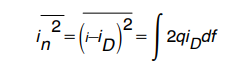
Where q is the electron charge (1.62 × 10^−19 C) and df is differential frequency. Shot noise is spectrally flat or has a uniform power density, meaning that when plotted versus frequency, it has a constant value. Shot noise is independent of temperature. The term q * I_D is a current power density having units A^2/Hz.
여기서 q는 전하량(1.62 × 10^−19 C)이고, df는 미분 주파수(주파수 대역폭)입니다. 산탄 노이즈는 스펙트럼 상으로 평탄하거나 균일한 전력 밀도를 가집니다. 즉, 주파수에 대해 그래프를 그리면 일정한 값을 나타냅니다. 또한 산탄 노이즈는 온도에 영향을 받지 않습니다. q * I_D 항은 A^2/Hz 단위를 가지는 전류 전력 밀도입니다.
Thermal Noise
Thermal noise is caused by the thermal agitation of charge carriers (electrons or holes) in a conductor. This noise is present in all passive resistive elements. Like shot noise, thermal noise is spectrally flat or has a uniform power density, but thermal noise is independent of current flow. Thermal noise in a conductor can be modeled as voltage or current. When modeled as a voltage it is placed in series with an otherwise noiseless resistor. When modeled as a current it is placed in parallel with an otherwise noiseless resistor.
열 잡음은 도체 내 전하 캐리어(전자 또는 정공)의 열적 동요(thermal agitation)로 인해 발생합니다. 이 노이즈는 모든 수동 저항성 소자에 존재합니다. 산탄 노이즈와 마찬가지로 열 잡음도 스펙트럼 상으로 평탄하거나 균일한 전력 밀도를 갖지만, 열 잡음은 전류의 흐름과는 무관합니다. 도체 내의 열 잡음은 전압 또는 전류 형태로 모델링할 수 있습니다. 전압으로 모델링할 때는 노이즈가 없는 저항과 직렬로 배치합니다. 전류로 모델링할 때는 노이즈가 없는 저항과 병렬로 배치합니다.
The average mean-square value of the voltage noise source or current noise source is calculated by: e^2 = 4 * k * T * R * df or i^2 = (4 * k * T / R) * df
전압 노이즈원 또는 전류 노이즈원의 평균 제곱값(mean-square value)은 다음과 같이 계산됩니다: e^2 = 4 * k * T * R * df 또는 i^2 = (4 * k * T / R) * df
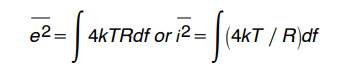
Where k is Boltzmann’s constant (1.38 × 10^−23 J/K), T is absolute temperature in Kelvin (K), R is the resistance of the conductor in ohms (Ω) and df is differential frequency.
여기서 k는 볼츠만 상수(1.38 × 10^−23 J/K)이고, T는 켈빈(K) 단위의 절대 온도, R은 옴(Ω) 단위의 도체 저항, df는 미분 주파수입니다.
The terms 4kTR and 4kT/R are voltage and current power densities having units of V^2/Hz and A^2/Hz.
4kTR 및 4kT/R 항은 각각 V^2/Hz 및 A^2/Hz 단위를 가지는 전압 및 전류 전력 밀도입니다.
Flicker Noise
Flicker noise is also called 1/f noise. It is present in all active devices and has various origins. Flicker noise is always associated with a dc current, and its average mean-square value is of the form:
e^2 = (K_e^2 / f) * df or i^2 = (K_i^2 / f) * df
플리커 노이즈는 1/f 노이즈라고도 불립니다. 모든 능동 소자에 존재하며 그 발생 원인은 다양합니다. 플리커 노이즈는 항상 직류(dc) 전류와 연관되어 있으며, 평균 제곱값은 다음과 같은 형태를 가집니다:
e^2 = (K_e^2 / f) * df 또는 i^2 = (K_i^2 / f) * df
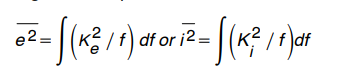
Where K_e and K_i are the appropriate device constants (in volts or amps), f is frequency, and df is differential frequency.
Flicker noise is also found in carbon composition resistors where it is often referred to as excess noise because it appears in addition to the thermal noise. Other types of resistors also exhibit flicker noise to varying degrees, with wire wound showing the least. Since flicker noise is proportional to the dc current in the device, if the current is kept low enough, thermal noise will predominate and the type of resistor used will not change the noise in the circuit.
여기서 K_e와 K_i는 해당 소자의 고유 상수(볼트 또는 암페어 단위)이고, f는 주파수, df는 미분 주파수입니다.
플리커 노이즈는 탄소 조성 저항기(carbon composition resistor)에서도 발견되는데, 열 잡음 외에 추가로 나타나기 때문에 흔히 '과잉 노이즈(excess noise)'라고도 불립니다. 다른 종류의 저항기들도 각기 다른 정도로 플리커 노이즈를 나타내며, 권선 저항기(wire wound)가 가장 적은 노이즈를 보입니다. 플리커 노이즈는 소자에 흐르는 직류 전류에 비례하므로, 전류를 충분히 낮게 유지하면 열 잡음이 지배적이게 되며, 어떤 종류의 저항기를 사용하더라도 회로의 전체 노이즈는 변하지 않게 됩니다.
The terms K_e^2 / f and K_i^2 / f are voltage and current power densities having units of V^2/Hz and A^2/Hz.
K_e^2 / f 및 K_i^2 / f 항은 각각 V^2/Hz 및 A^2/Hz 단위를 가지는 전압 및 전류 전력 밀도입니다.
Burst Noise
Burst noise, also called popcorn noise, appears to be related to imperfections in semiconductor material and heavy ion implants. Burst noise makes a popping sound at rates below 100 Hz when played through a speaker. Low burst noise is achieved by using clean device processing.
팝콘 노이즈라고도 불리는 버스트 노이즈는 반도체 물질의 결함 및 고에너지 이온 주입(heavy ion implants)과 관련이 있는 것으로 알려져 있습니다. 버스트 노이즈를 스피커로 들으면 100 Hz 미만의 빈도로 탁탁 튀는(popping) 소리가 납니다. 버스트 노이즈를 낮추기 위해서는 깨끗한 소자 공정 과정을 거쳐야 합니다.
Avalanche Noise
아발란치 노이즈 (Avalanche Noise / 산사태 노이즈)
Avalanche noise is created when a pn junction is operated in the reverse breakdown mode. Under the influence of a strong reverse electric field within the junction’s depletion region, electrons have enough kinetic energy that, when they collide with the atoms of the crystal lattice, additional electron-hole pairs are formed. These collisions are purely random and produce random current pulses similar to shot noise, but much more intense.
아발란치 노이즈는 PN 접합이 역방향 항복(reverse breakdown) 모드로 동작할 때 생성됩니다. 접합부 공핍 영역 내의 강한 역방향 전계의 영향으로 인해, 전자는 결정 격자의 원자와 충돌할 때 추가적인 전자-정공 쌍을 형성할 만큼 충분한 운동 에너지를 얻게 됩니다. 이러한 충돌은 순수하게 무작위적이며 산탄 노이즈와 유사하지만 훨씬 더 강렬한 무작위 전류 펄스를 발생시킵니다.
목차 확인
https://brush-up.tistory.com/431
Noise Analysis inOperational Amplifier Circuits(1)
아래 문서 내용에 대한 번역 및 정리이다. https://www.ti.com/lit/an/slva043b/slva043b.pdf?ts=1780557822918&ref_url=https%253A%252F%252Fwww.google.com%252F Noise Analysis in Operational Amplifier Circuits연산 증폭기(Op-Amp) 회로에서
brush-up.tistory.com
'시스템 반도체 설계 > Amplifier' 카테고리의 다른 글
| Noise Analysis in Operational Amplifier Circuits (4) Noise Characteristics (0) | 2026.06.07 |
|---|---|
| Noise Analysis in Operational Amplifier Circuits (2) (0) | 2026.06.05 |
| Noise Analysis inOperational Amplifier Circuits(1) (0) | 2026.06.04 |